Neutral vs Stability Running Shoes: Key Differences and How to Choose
Confused between neutral and stability running shoes? We explain the key differences, who each type is best for, and how to choose based on your foot mechanics.
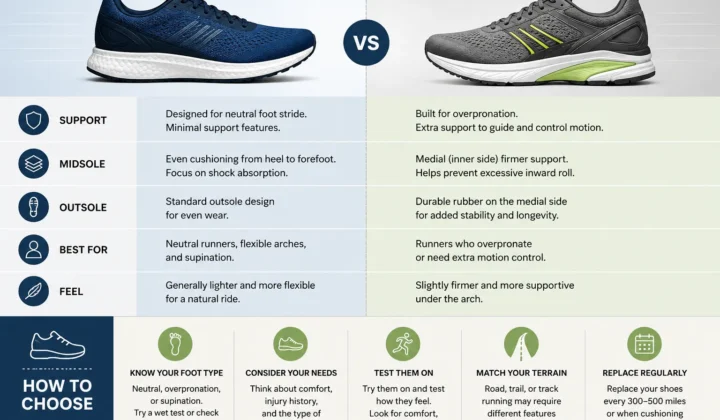
If you’ve ever stood in a running shop trying to decide between neutral and stability running shoes, you’re not alone. It’s one of the most common questions runners face, whether you’re training for your first 5K or preparing for a marathon. The terminology can feel overwhelming, but understanding the difference between these two running shoe types is genuinely important — choosing the wrong category can lead to discomfort, inefficiency, and even injury over time.
The distinction comes down to foot mechanics. How your foot moves as it strikes the ground and rolls through the gait cycle determines which type of shoe will support you best. This guide breaks down everything you need to know about neutral vs stability running shoes, from the core biomechanical differences to practical advice on identifying which shoe type matches your running style in 2026.
Our Read How to Break In New Running Shoes (Without Getting Blisters)
Neutral vs Stability Running Shoes
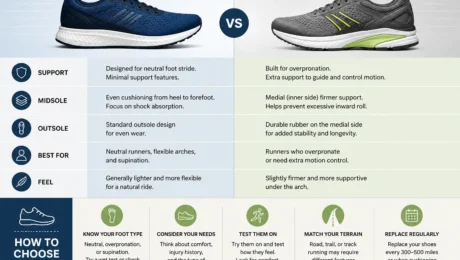
Neutral running shoes are designed for runners with a neutral gait or those who underpronate (supinate). Stability running shoes are built for runners who overpronate, meaning the foot rolls inward excessively during the gait cycle. Choosing between them depends on your foot mechanics, arch type, and how your foot naturally strikes and rolls through each step.
What Are Neutral Running Shoes?
Neutral running shoes are built without corrective support elements. They feature consistent cushioning throughout the midsole and are designed to let the foot move along its natural path without any additional guidance. This makes them the right choice for runners whose feet don’t roll inward significantly when they run.
Most neutral shoes prioritise cushioning, energy return, and lightweight construction. Models like the Brooks Ghost, ASICS Gel-Nimbus, and HOKA Clifton are strong examples — each offering generous midsole cushioning to absorb impact across high weekly mileage without attempting to alter the foot’s natural movement pattern.
Our Read How to Find Your Running Gait: A Step-by-Step Guide
The Nike Pegasus and Saucony Ride are also popular neutral daily trainers known for their versatility. They perform well across easy runs, tempo work, and longer efforts, which is why they’ve remained consistent recommendations for neutral runners for several years running.
Who Should Wear Neutral Running Shoes?
- Runners with a neutral gait (no significant inward roll)
- Runners who underpronate or supinate (foot rolls outward)
- Those with high arches
- Experienced runners with strong foot and ankle mechanics
- Runners who prefer a more flexible, responsive ride
What Are Stability Running Shoes?
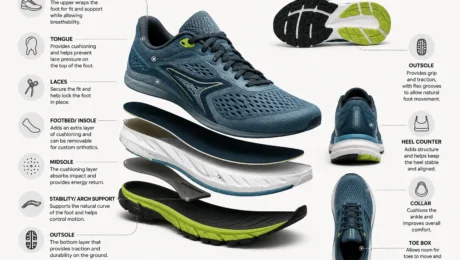
Stability running shoes include structural features designed to reduce excessive inward rolling of the foot, known as overpronation. The most common mechanism is a dual-density midsole or a firmer foam posted on the medial (inner) side of the shoe, which slows and limits the degree to which the arch collapses with each footstrike.
Modern stability shoes have evolved considerably. Earlier designs were noticeably stiffer and heavier, but current options offer genuine cushioning comfort alongside their support features. The New Balance Fresh Foam stability line and several ASICS structured support models now deliver plush underfoot feel without sacrificing the corrective function that overpronators need.
It’s worth noting that stability shoe benefits extend beyond injury prevention. Many runners find that a well-matched stability shoe improves their running efficiency, because a better-supported foot position means energy is directed more cleanly through each stride rather than being lost to lateral movement.
Who Should Wear Stability Running Shoes?
- Runners who overpronate (foot rolls inward excessively)
- Those with flat feet or low arches
- Runners who experience medial knee pain or shin splints
- Heavier runners who need additional support under load
- Those recovering from lower limb injuries related to gait mechanics
Understanding Pronation: The Core Concept
Pronation is simply the natural inward rolling motion of the foot as it transitions from heel strike to toe-off. It’s a normal and necessary part of the gait cycle — the issue is only when this rolling goes beyond the neutral range.
Neutral pronation means the foot rolls inward by roughly 15 degrees after the heel strikes the ground. This is biomechanically efficient and places load evenly across the foot.
Overpronation describes a roll greater than 15 degrees, where the arch collapses more significantly. This can place stress on the medial knee, ankle, and plantar fascia over time. A neutral shoe for overpronation won’t provide the structure needed to manage this — it’s one of the clearest cases where a stability shoe matters.
Underpronation (supination) is the opposite: the foot rolls outward rather than inward. Supinators typically need soft, cushioned neutral shoes that allow natural foot movement and absorb the shock concentrated on the outer foot.
How to Identify Your Foot Type
There are several practical ways to assess which category you fall into before investing in a new pair of running shoes.
The Wet Foot Test
Wet the bottom of your foot and step onto a piece of dark paper or cardboard. A normal arch leaves a band connecting the heel and forefoot. A flat arch leaves a nearly complete footprint. A high arch leaves only a narrow band or almost no midfoot print at all.
Gait Analysis
Many specialist running retailers offer treadmill-based gait analysis, which provides a far more accurate picture than any static test. A trained staff member can identify your pronation pattern from video footage of your running stride and recommend appropriate running shoe support types accordingly.
Check Your Shoe Wear Pattern
Look at the outsole of an old pair of running shoes. Heavy wear on the inner heel and forefoot suggests overpronation. Wear concentrated on the outer edge indicates supination. Even wear across the ball of the foot and heel is characteristic of a neutral gait.
Heel-to-Toe Drop and Its Relationship to Support
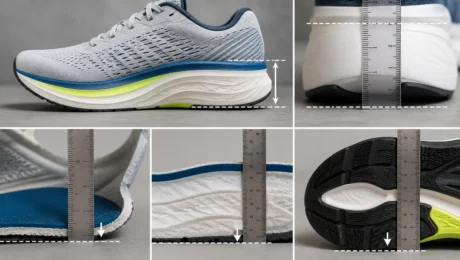
Heel-to-toe drop — the difference in stack height between the heel and forefoot — is a separate but related consideration. Lower-drop shoes (4mm and under) tend to encourage a more midfoot strike and can reduce strain on the knee, but they place greater demand on the calf and Achilles. Higher-drop shoes (10mm and above) are more forgiving for heel strikers and are common in traditional daily trainers.
Stability features and heel-to-toe drop are independent variables. You can find stability shoes across the full drop spectrum, so don’t conflate the two when making your choice.
Frequently Asked Questions
Can I wear a neutral shoe if I overpronate slightly?
Mild overpronation may be manageable in a neutral shoe, especially if you have strong foot and ankle muscles. However, if you regularly experience medial knee pain, shin splints, or plantar fascia discomfort, switching to a stability shoe is worth trying. A gait analysis will give you a clearer answer than guessing.
Are stability shoes heavier than neutral running shoes?
They were historically heavier due to added medial support structures, but modern stability shoes have closed the gap significantly. Several current stability models are competitive in weight with neutral daily trainers, so weight alone shouldn’t be a deciding factor in 2026.
What are the main stability shoe benefits for overpronators?
Stability shoes reduce the degree of inward foot roll, which helps distribute impact load more evenly across the lower limb. This can reduce cumulative stress on the medial knee, ankle, and plantar fascia, particularly during high-mileage training blocks or longer race distances.
Is a neutral shoe good for overpronation if I add an orthotic?
Custom orthotics can provide meaningful support inside neutral shoes, and some podiatrists prefer this approach for precise gait correction. However, if you’re using an off-the-shelf insole rather than a custom orthotic, pairing it with a stability shoe is generally the more effective and cost-efficient solution for overpronation.
How long do stability running shoes last compared to neutral shoes?
Both shoe types typically last between 500 and 800 kilometres, though midsole compression can reduce effectiveness before the outsole shows significant wear. Heavier runners may reach that threshold faster. Replace your shoes based on mileage rather than appearance alone, as degraded cushioning and support can increase injury risk even when the upper looks intact.
Conclusion
Choosing between neutral and stability running shoes doesn’t have to be complicated once you understand your foot mechanics. Neutral shoes work well for runners with efficient, neutral gaits, while stability shoes provide essential support for those who overpronate. The right choice has a genuine impact on comfort, performance, and injury resilience over thousands of kilometres of training. If you’re unsure which category suits you, a gait analysis at a specialist running retailer is the most reliable route to an informed decision. Invest the time before you invest in the shoe — your feet will thank you for it.
Have you been fitted for a neutral or stability shoe? Did it make a difference to how you feel on a run? Share your experience in the comments below — we’d love to hear what worked for you.