How to Find Your Running Gait: A Step-by-Step Guide
Not sure if you overpronate or supinate? Follow our simple step-by-step guide to identify your running gait and find the right shoe type for your stride.

Buying the right running shoes starts with one thing most people skip entirely — understanding how your foot actually moves when you run. Knowing how to find your running gait is the foundation of smarter shoe selection, injury prevention, and long-term running comfort. Run in the wrong shoe for your gait type and you’re working against your own body with every stride.
Your running gait describes the complete cycle of movement your foot makes from the moment it strikes the ground to when it lifts off again. Within that cycle, the way your foot rolls inward — a motion called pronation — varies from runner to runner. Some people’s feet roll too far inward (overpronation), others barely at all (supination), and many fall somewhere in the middle (neutral).
Our Read How to Break In New Running Shoes (Without Getting Blisters)
The good news is that identifying your gait type doesn’t require expensive equipment or a specialist appointment — though those help. There are several reliable methods you can use right now to understand your foot strike and pronation pattern, and use that knowledge to find the right shoe category for your stride.
To find your running gait, try the wet foot test, examine the wear pattern on your old running shoes, or record yourself running from behind on a flat surface. These three methods reveal whether you overpronate, supinate, or have a neutral gait. Alternatively, visit a specialist running store for a professional gait analysis, which is usually offered free of charge.
What Is Running Gait and Why Does It Matter?
Running gait refers to the biomechanical pattern of how your body moves through each stride. More specifically, when talking about gait type in running, most discussions focus on pronation — the natural inward rolling motion of the foot that occurs between heel strike and toe-off. This rolling motion is a normal shock-absorption mechanism, but the degree to which it happens determines which category of running shoe will support your foot most effectively.
Getting your gait type right when selecting shoes matters for two key reasons. First, the wrong shoe can amplify existing biomechanical inefficiencies, increasing your injury risk over time. Secondly, a shoe matched to your gait improves comfort, running economy, and durability of both the shoe and your body.
The Three Gait Types Explained
Neutral Pronation
A neutral gait means your foot lands on the outer edge of the heel and rolls inward by approximately 15 degrees before pushing off evenly from the front of the foot. This is the most mechanically efficient gait pattern and affects the majority of runners. Neutral runners have the widest range of shoe options available, as they don’t require additional corrective support. Neutral daily trainers like the Brooks Ghost, ASICS Gel-Nimbus, or Saucony Ride are well-suited to this gait type.
Overpronation
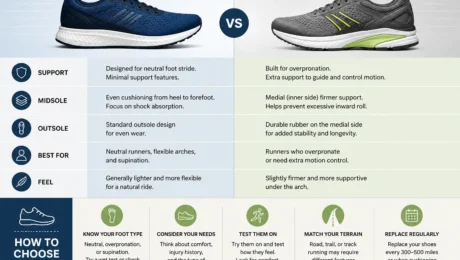
Overpronation occurs when the foot rolls inward excessively beyond that natural 15-degree arc during the gait cycle. The arch collapses more than it should, placing additional stress on the ankle, knee, and hip. Overpronation is the most common gait irregularity and is particularly prevalent in runners with low arches or flat feet. Stability and motion control running shoes are designed specifically to counter this pattern, using medial post support and firmer midsole foam on the inner side of the shoe to limit excess inward rolling.
Supination (Underpronation)
Supination — also called underpronation — is the opposite pattern, where the foot rolls outward rather than inward during the gait cycle. It’s less common than overpronation and tends to occur in runners with high, rigid arches. Supinators don’t absorb impact efficiently and are prone to lateral ankle stress, IT band issues, and stress fractures. Cushioned neutral shoes with flexible midsoles are the recommended choice, as they compensate for the reduced natural shock absorption.
Our Read Running Shoe Anatomy Explained
How to Find Your Running Gait at Home
Method 1: The Wet Foot Test
The wet foot test is the simplest and most accessible overpronation test available. Here’s how to do it:
- Wet the sole of your bare foot thoroughly.
- Step onto a piece of plain paper or a dry, flat surface where the footprint will show clearly.
- Step off and examine the impression left behind.
Interpreting the result:
- A full, wide footprint with little curve on the inner edge — indicates low arches and a tendency toward overpronation.
- A footprint showing a clear, distinct curve inward with a narrow band connecting heel and forefoot — indicates a neutral arch and neutral gait.
- A footprint showing only the heel and ball with little or no connecting band — indicates high arches and a tendency toward supination.
The wet foot test gives a strong indication of arch height, which correlates closely with gait type, though it’s not a perfect substitute for a full running gait analysis.
Method 2: Examine Your Old Running Shoe Wear Pattern
One of the most revealing tools for identifying gait type is a pair of well-worn running shoes. Flip them over and examine where the outsole has worn down most significantly.
- Wear concentrated on the inner edge of the heel and forefoot — indicates overpronation.
- Even wear across the heel and ball of the foot, slightly toward the outer edge — indicates neutral pronation.
- Wear heavily concentrated on the outer edge of the shoe — indicates supination.
This method works best with shoes that have been used for at least 150–200 miles, as the wear pattern becomes clearly established over time. New or lightly used shoes won’t show enough wear to draw reliable conclusions.
Method 3: Video Analysis at Home
Recording yourself running is a more accurate DIY approach to running gait analysis. Set up a phone to record from directly behind you at ankle height as you run on a flat surface at your natural pace. Slow the footage down and observe how your foot behaves between heel strike and toe-off.
- If the ankle collapses significantly inward — overpronation.
- If the ankle remains relatively upright with slight inward roll — neutral.
- If the ankle tilts outward — supination.
Even a brief clip of ten to fifteen strides gives enough information to identify a consistent pattern.
Professional Gait Analysis: When to Get One
While the home methods above are genuinely useful starting points, a professional running gait analysis provides a far more complete and accurate picture of your biomechanics. Most specialist running retailers offer this service free of charge, using treadmill-based video capture and slow-motion playback to assess your foot strike, cadence, hip alignment, and overall running mechanics in detail.
A professional gait analysis is particularly worthwhile if you experience recurring injury, are returning to running after a long break, or are transitioning to a significantly different shoe type. The assessment takes around 20–30 minutes and typically concludes with specific shoe recommendations matched to your individual pattern — removing the guesswork entirely from your next purchase.
Matching Gait Type to the Right Running Shoe
- Neutral gait: Neutral cushioned trainers — Brooks Ghost, HOKA Clifton, Saucony Ride, ASICS Gel-Nimbus.
- Mild overpronation: Support or stability shoes with medial post — ASICS Gel-Kayano, Brooks Adrenaline GTS, New Balance Fresh Foam 860.
- Severe overpronation: Motion control shoes with maximum medial support and a firm midsole.
- Supination: Well-cushioned neutral shoes with flexible, forgiving midsoles — HOKA Clifton, Nike Pegasus, Saucony Ride.